Convex grind
The outer face curves down to a very fine edge. The inner face is hollowed, so the blades only touch where they cross.
Japanese scissors suit slicing and fine detail; German scissors suit blunt lines and over-comb work. How the edges differ and when to choose each.
By SalonScissors editorial team Updated
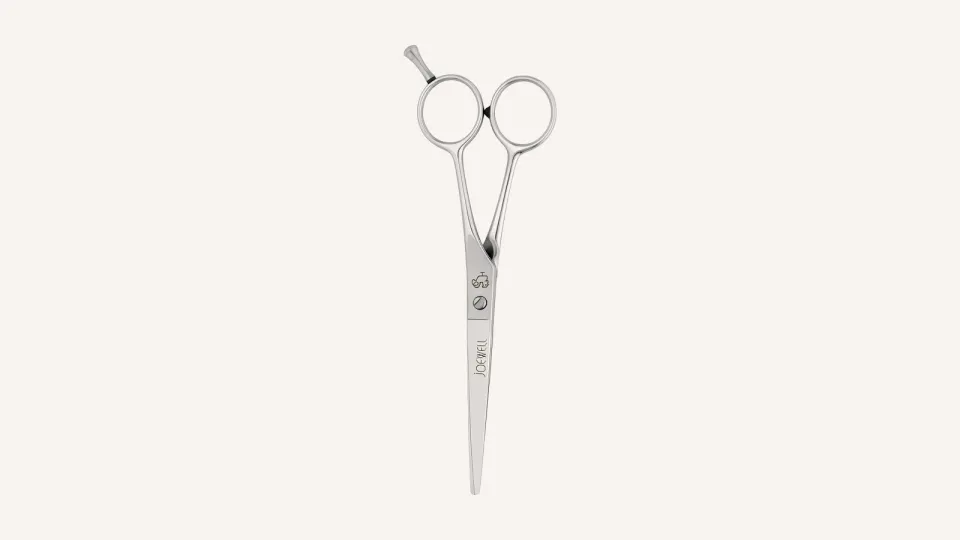
The real difference is the edge. Here’s which one suits your work.
How we chose: We compared maker specs from Joewell, Yasaka and Jaguar. This store sells Japanese brands, not German ones, and we haven’t run cutting tests. Prices checked 15 October 2026.
Edges, steels and hardness come from each maker’s own glossary and model pages. Prices, hands and options come from our listings.
It comes down to the edge. Japanese makers are known for convex edges. German makers, such as Jaguar in Solingen, are known for bevelled and micro-serrated ones.
| Edge | What it does | Good for |
|---|---|---|
| Convex | Curves out to a very fine cutting angle | Slicing, point cutting, detail |
| Bevel | A flat ground face with a sturdy edge | Blunt lines, everyday cutting |
| Micro-serrated | Fine teeth hold the hair still | Blunt lines, over-comb, dry hair |
Jaguar’s scissor glossary describes all three: a convex edge has “a very fine, pointed cutting angle”, a bevel gives “a robust cutting geometry”, and micro-serration stops hair slipping away as you close.
The outer face curves down to a very fine edge. The inner face is hollowed, so the blades only touch where they cross.
The outer face is ground flat down to the edge. Joewell calls its flat single bevel easy to use.
Each grind is drawn as one blade cut across, enlarged. Makers explain their own: Kasho’s edge and Joewell’s blade guide.
Go Japanese when most of your cutting moves through the hair rather than straight across it.
Our pick: the Yasaka SA Classic. Our listing describes a clam-shaped convex slice edge on a level-ring handle, and Yasaka lists the SA-5.5 with a 60 mm blade in SUS440C steel. Keep in mind: level rings sit differently in the hand from an offset pair. On a budget, the Mina Sakura II has a convex edge on an offset handle.
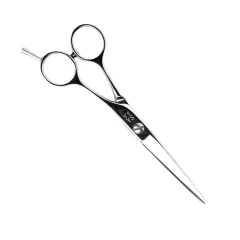
Yasaka SA Classic Precision Scissors
Best for slicing with a convex edge
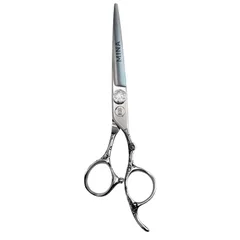
Mina Sakura II Hair Cutting Scissors
Best for a convex edge on a budget
Go German when you mostly cut straight across: blunt lines, perimeters and scissor-over-comb.
We don’t stock German scissors here, but we do stock Japanese pairs with that style of edge. Our pick: the Mina Classic II, a micro-serrated bevel edge on a semi-offset handle. Keep in mind: a serrated edge grips hair, so it won’t slide cut. The Joewell Classic Serrated does the same job on Joewell’s level-ring handle.
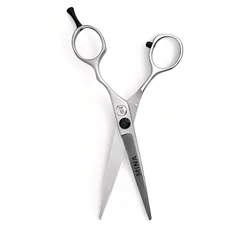
Mina Classic II Hair Cutting Scissors
Best for blunt lines on a budget
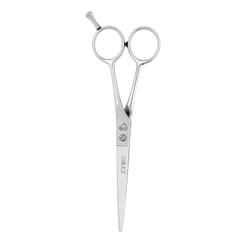
Joewell Classic Serrated Hair Cutting Scissors
Best for a serrated edge with level rings
Set on a German brand? Our store directory lists Australian stores that carry Jaguar.
Whatever the country, compare these on the exact model:
| Detail | Buying question |
|---|---|
| Edge | Do you want a smooth blade for drawn strokes, or a serrated edge that holds a section? |
| Length | Will you work close to the fingers, or across full sections and over a comb? |
| Handle | Do you prefer level rings, an offset thumb or a swivel thumb? |
| Service | Can your sharpener work on the edge and pivot system this model uses? |
The country is a starting point, not the spec. Two makers’ own pages show why:
So read the edge on the model’s page before the flag on the box. Our convex edge guide explains the terms.
Not across the board. Japanese pairs usually suit slicing and detail, and German pairs usually suit blunt lines and over-comb work. Pick the edge that matches the cut you do most.
Often, yes. A micro-serrated blade holds dry hair still for blunt lines and scissor-over-comb. For over-comb work, a 6.5” to 7.0” blade helps, whichever country it comes from.
Yes, with a convex model made for it. Jaguar lists slicing and sliding cuts for its Convex Flex. Skip micro-serrated blades for slide cutting, because they grip the hair.
A convex edge needs a sharpener who works on convex edges, wherever the pair was made. Give them the maker and model so they keep the original edge, or ask us about sharpening.
Answer a few questions in the scissor finder and it’ll shortlist pairs by hand, size and budget. For two Japanese makers side by side, read Yasaka vs Joewell, or see how edges and blade shapes work in the blade guide.
Tell us what you cut and which scissors you are comparing.
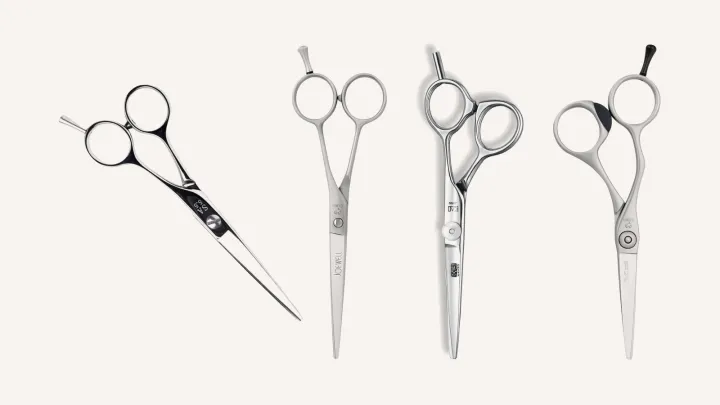
Our 10 Japanese picks, mid-range to premium: the Ichiro Taiyo under A$300, Yasaka SA for level rings, Classic PRO for detail and FX LEFTY for left-handers.
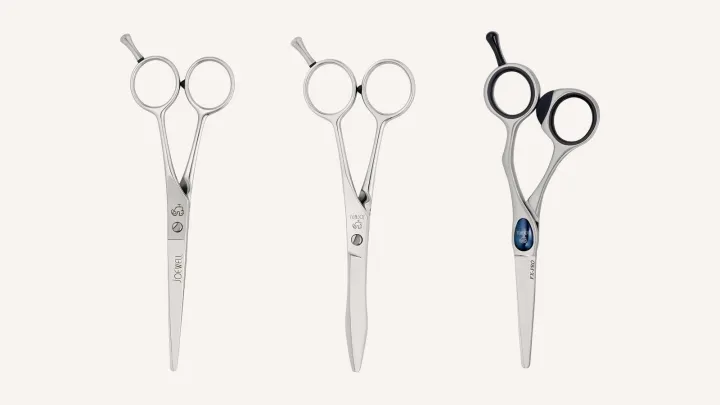
Convex, bevelled, micro-serrated, sword and bamboo-leaf blades: what each one does, which cut it suits, and how to read the blade words on a listing.