Thinning Scissor Cut Ratios, Explained
By SalonScissors editorial team Updated
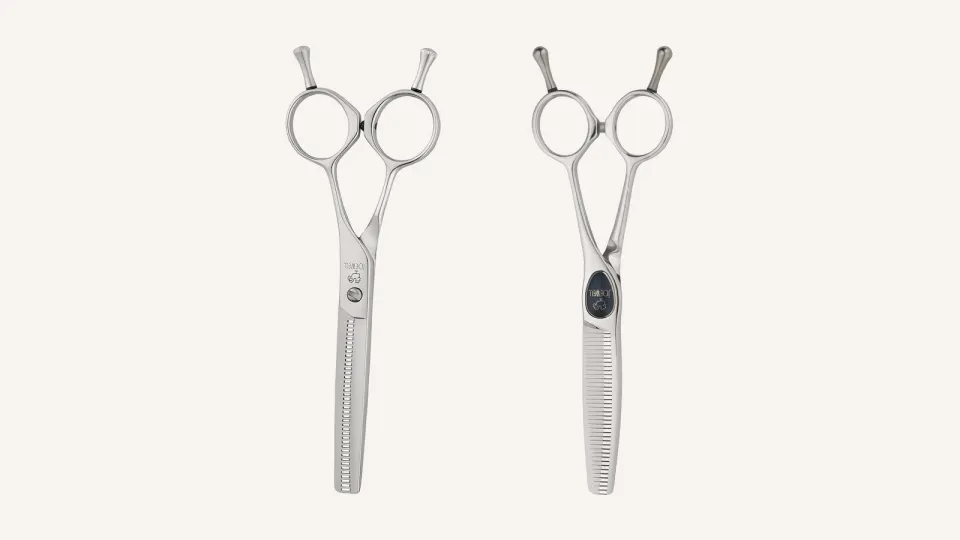
A cut ratio is the maker’s estimate of how much of a section a thinner takes out in one close.
How we chose: Thinners whose maker or listing gives a cut ratio, picked on those figures and price. We sell them and haven’t run cutting tests. Prices checked 15 October 2026.
Same teeth, different result
Joewell E-40
- Teeth
- 40
- Cut ratio
- 35%
Joewell’s basic thinner, with a symmetric handle.
Joewell SNT-40
- Teeth
- 40
- Cut ratio
- About 5% or less
Catches single hairs at the tips of its comb teeth, for volume control.
The difference is in the teeth, not the count. Joewell says “cut ratio differs depending on the number of teeth and shape on the comb blade”, so the shape of each tooth and its groove can matter as much as how many there are.
What do real cut ratios look like?
| Thinner | Teeth | Cut ratio |
|---|---|---|
| Joewell SNT-40 | 40 | About 5% or less |
| Joewell E-30 | 30 | 15% |
| Joewell E-40 | 40 | 35% |
| Joewell JGC-12 | 12 | About 80% |
| Yasaka YS-30 | S 7–10% W 20–25% T 30–35% | |
| Ichiro Texture Master | 30 | W 10–15% V 20–25% H 30–35% |
| Juntetsu Cobalt texturiser | 30 | Finesse 15% Blend 20% Sculpter 30% |
Joewell and Yasaka figures come from their own model pages; the Ichiro and Juntetsu figures are the option names on our listings. Three of these have 30 teeth and still run from 10% to 35%, depending on the option you pick.
Why don’t teeth predict the ratio?
Same number of teeth, deeper grooves
Top: shallow grooves at the tooth tips. Bottom: deeper grooves. Joewell says deeper grooves are how its 35-tooth JBT-35 takes out about 40%, against about 25% for its conventional 35-tooth thinner.
Groove depth, tooth shape and spacing all change how much hair each tooth catches. Joewell’s JGC-12 shows the other extreme: 12 teeth and about 80%, sold as a cutting shear that leaves a natural texture.
Which cut ratio should you choose?
- About 5–15%: finishing and fine hair. Our listing calls Ichiro’s 10–15% W-style a lighter finishing pass. The SNT-40 is the lightest here.
- About 20–25%: everyday blending. Ichiro’s V-style is listed for general blending, and Juntetsu’s Blend sits at 20%.
- About 30–35%: weight removal on thick hair. Joewell’s E-40, Yasaka’s YS-30T and Ichiro’s H-style all sit here.
- Much higher: cutting texture in. The JGC-12’s 80% is closer to a cutter than a blender.
Start lower than you think. You can always take a second pass; you can’t put hair back.
What if there’s no cut ratio?
Plenty of thinners don’t list one. Don’t guess it from the teeth; ask us with the product link, and we’ll tell you what the maker says, or that it doesn’t say.
Common questions
What does a 30% thinning scissor mean?
Its maker rates it to take out about 30% of the hair in a section with one close. It’s the maker’s estimate, so treat it as a guide and check after each pass.
Are 30 or 40 teeth better?
Neither, by count. Joewell’s 30-tooth E-30 is rated 15% and its 40-tooth E-40 35%, while its 40-tooth SNT-40 is about 5% or less. Choose by cut ratio and tooth design.
Is a higher cut ratio better?
Only for heavier work. A higher ratio takes out more per close, which suits thick hair. For fine hair and finishing, a lower ratio is easier to control.
Can I compare cut ratios between brands?
Roughly. Makers don’t share one test method, so compare within one brand’s range first, and treat a cross-brand gap of a few percent as noise.
Next step
Know the ratio you want? The thinning scissor guide matches thinners to blending, weight removal and texture, with picks in each.