Damascus Hair Scissors, Explained
By SalonScissors editorial team Updated
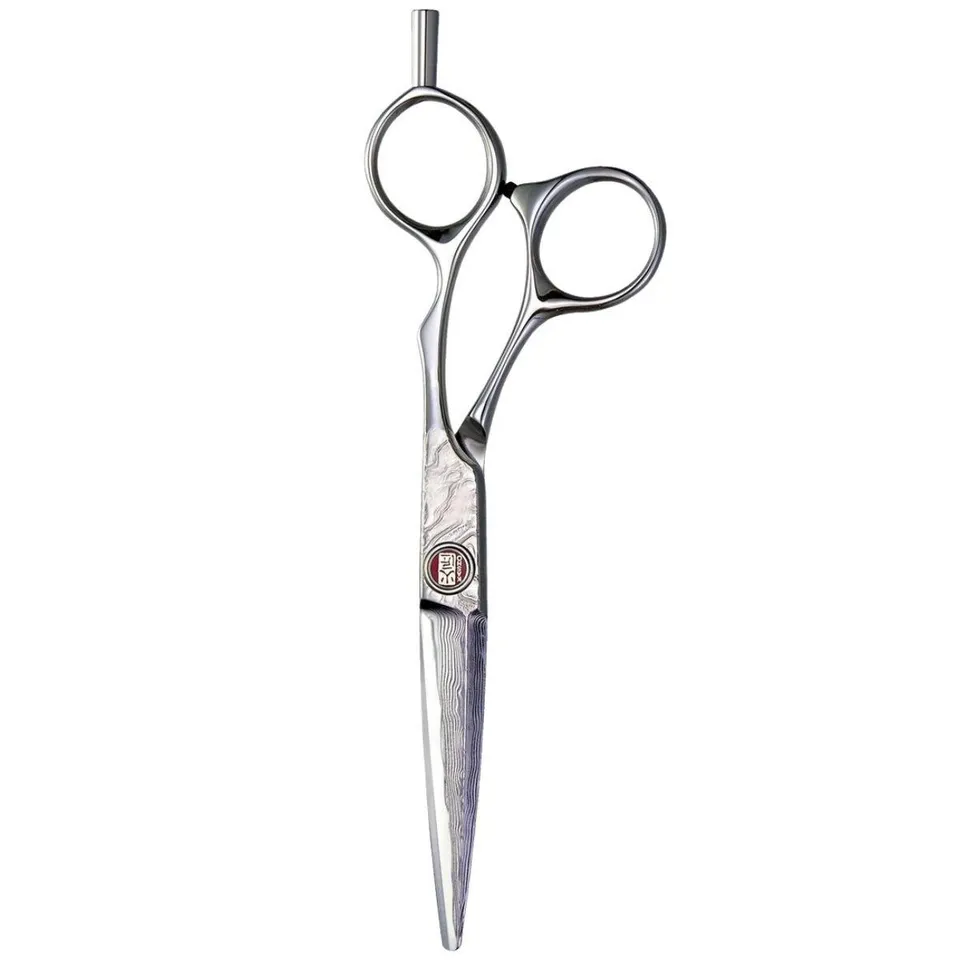
Damascus is a blade built from layers of steel, so a wavy pattern shows on the surface. It’s a pattern, not a steel grade.
How we chose: The two Damascus cutters in our range, compared on maker specs, listings and price. We sell both and haven’t run cutting tests. Prices checked 15 October 2026.
How is a Damascus scissor made?
Kasho says its Damascus blades are built from “alternating layers of steel, each little thicker than a human hair”, in what it calls V10 cobalt alloy steel, combined with a core steel. Those layers are the wavy lines you see along the blade.
Kasho makes it in three offset sizes: KAD-55 OS, KAD-60 OS and KAD-65 OS, or 5.5”, 6.0” and 6.5”. Each has Kasho’s ball-bearing pivot with an adjustable flat-head screw.
Does the pattern change how it cuts?
No. The pattern sits on the blade faces; the cut happens at the edge, where the steel, its hardness and the grind are what count.
Convex grind
The outer face curves down to a very fine edge. The inner face is hollowed, so the blades only touch where they cross.
Bevelled grind
The outer face is ground flat down to the edge. Joewell calls its flat single bevel easy to use.
Each grind is drawn as one blade cut across, enlarged. Makers explain their own: Kasho’s edge and Joewell’s blade guide.
What you’re paying for in the Kasho is the whole tool: the layered blade, a sword-style blade, an offset handle and that pivot. Judge it on those, the way you’d judge any premium cutter.
How do the two Damascus pairs compare?
| Kasho Damascus Offset | Juntetsu Matte Black Damascus | |
|---|---|---|
| Pattern | Layered steel | Black Damascus-style finish |
| Steel named | V10 cobalt alloy (Kasho’s wording) | Not named |
| Sizes | 5.5”, 6.0” or 6.5” | 6.0” only |
| Handle | Offset | 3D offset |
Our Juntetsu listing describes a coated black blade with a Damascus-style pattern. If you want true layered steel, the Kasho is the one; if you want the look and a convex 6.0” cutter, the Juntetsu does it for far less.
What about powder Damascus?
It’s another way to make the pattern. Mizutani, for example, says it mixes two types of fine powder so the pattern runs right through the blade. We don’t stock any. The powder steel guide explains how powder steel is made.
How do you look after a Damascus finish?
Like any patterned or coloured finish: the finish care steps apply. Two things matter most:
Common questions
Is Damascus steel better for hair scissors?
Not by itself. The pattern is looks; the steel at the edge, its hardness and the grind decide how it cuts. A Damascus pair from a good maker can be excellent, for the same reasons a plain one is.
Is Damascus a coating?
True Damascus isn’t: it’s layers of steel, as on the Kasho. Some scissors carry a Damascus-style pattern finish instead, like our Juntetsu Matte Black Damascus. Read the listing to see which you’re getting.
What steel is in a Kasho Damascus?
Kasho calls it V10 cobalt alloy steel and doesn’t name the core grade beyond that. We keep Kasho’s wording; ask us if the exact grade matters to you.
Will the pattern wear off?
On layered steel, no: the pattern is in the metal. Scratches and chemical marks still spoil the look, so wipe, dry and case it after every client.
Next step
Like the Kasho but not the price? The steel guide shows what each steel gives you, from 440C up to powder steel.