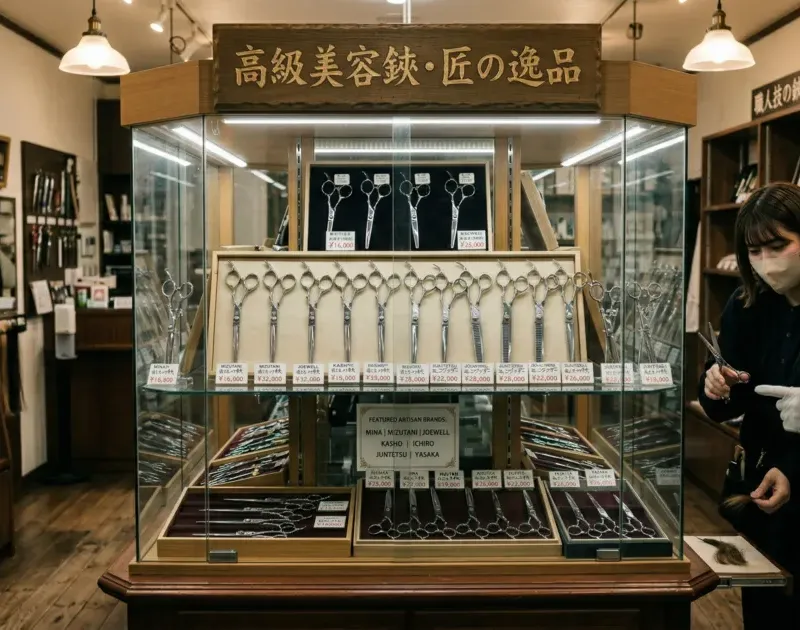
Japanese and German Scissors: Compare the Blade, Not the Label
A salon buying guide to comparing edge, handle, size and service needs across Japanese and German scissor models.

Country labels can help you find a brand, but they do not tell you how every scissor will cut. A Japanese model may have a classic handle and a German model may have an offset one. Compare the actual tool in your hand.
Four details to check
| Detail | Buying question |
|---|---|
| Edge | Do you want a smooth blade for drawn strokes or a serrated edge that holds a section? |
| Length | Will you work close to the fingers or across full sections and over a comb? |
| Handle | Do you prefer level rings, an offset thumb or a moving-ring design? |
| Service | Can your sharpener work on the edge and pivot system this model uses? |
Make a two-scissor comparison
Choose one model from each range in the same size and for the same job. Compare their blade profiles and handle layouts, then check the product listings for the specific steel and care details. A 5.5-inch detail cutter and a 7.0-inch over-comb shear will feel different for reasons that have little to do with origin.
If you already know your main technique, the cutting shears collection is a better starting point than a country debate. The buyers guide explains how to narrow the field by size, edge and handle.
Notes for your salon kit
Cutting ideas, model comparisons and simple scissor care for busy stylists.