Detail, Neckline and Short-Shank Scissors: Tools for Small Jobs
By SalonScissors editorial team Updated
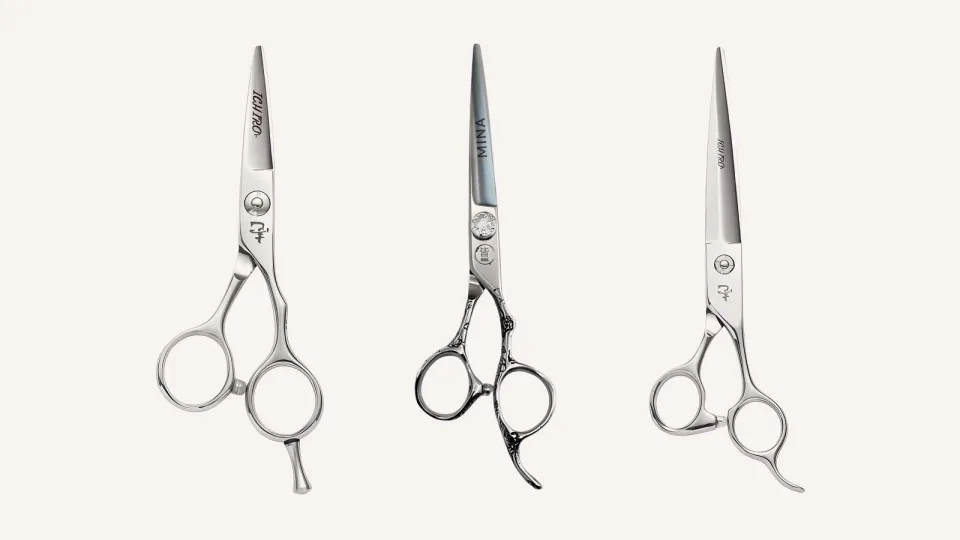
Small-scissor names describe a job more than a standard design. “Neckline scissors” or “detail scissors” on a product page doesn’t tell you the blade length, the tip or the handle fit. This guide shows what each name usually means and which measurements to check instead.
How we chose: Descriptions follow how makers and trade sources use the terms. Reviewed 4 November 2026. We sell scissors and haven’t run cutting tests.
What are detail scissors?
Detail scissors are very short professional cutters, used on small sections or in tight spaces. They sit at the short end of the range, often around 4.5” to 5.0”, though makers don’t agree on one class. “Mini”, “detail” and “precision” all overlap.
They suit pinpoint work such as adjusting a face line, fine volume control and detailed men’s cutting. A short blade reaches tight places easily, but it needs more closes along a long line, so a longer precision cutter may be quicker for that job. A short blade doesn’t make a scissor safer near skin either.
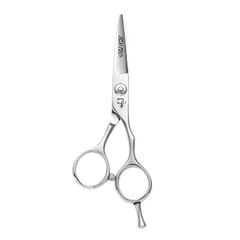
Ichiko Precision
Best for close work around the fringe, ears and a tight nape
A$244.95
View Ichiko PrecisionCompare lengths across our 5.0” scissors or the wider cutting scissors range.
What are neckline scissors?
“Neckline scissors” is a task name, not a standard type. Neckline work is a normal part of haircutting, but we haven’t found a separate scissor build that makers consistently sell under that name.
The finish decides the tool:
- A detail or ordinary cutter can remove stray hairs and make a scissored outline.
- A thinning or modelling scissor can soften density where the technique suits.
- Clippers or trimmers make a machine-defined outline.
Treat “neckline” in a product title as a hint, then check the blade length, edge, tip, handle and hand. Barbers get more on the tools for ears and necklines in the barber scissors guide.
What does short shank mean?
Short shank describes a build where the shank, the part between the pivot and the finger ring, is short. You’ll mostly see it on pet-grooming scissor listings. We haven’t found it as a named category in hairdressing scissors.
It doesn’t mean short blades, small rings or a particular balance. A long scissor can have a short shank. To judge hand fit on a pair for human hair, compare overall length, blade length, the reach from pivot to ring, ring size and weight, rather than searching for the phrase.
What about curved, kids, beard and eyebrow scissors?
| Tool | What it is | What to check |
|---|---|---|
| Curved | A blade or cutting line that’s deliberately curved, mostly for slide and stroke work | Curve direction and depth, and whether your sharpener can keep the geometry |
| Kids haircut | Sharp haircutting scissors, often with rounded ends, for an adult cutting a child’s hair | Who holds it. They aren’t craft scissors for a child |
| Beard and moustache | Short blades for trimming facial hair, sometimes micro-serrated, with flattened or rounded ends | Tip shape, ring size and edge. The edges are still sharp near lips and skin |
| Eyebrow | Small pointed, curved, angled or comb-attached tools | The construction, which is right-hand only on some comb styles, plus a mirror and good light |
A rounded tip removes one hazard, but the blades still cut skin. Stop if a child moves unpredictably, and keep control of the tool. Facial and brow tools bought for personal grooming aren’t automatically right for use on several clients. Follow the maker’s instructions and your local requirements for cleaning.
How do you read scissor sizes?
Keep three measurements apart. They’re not the same, and makers don’t measure them the same way.
- Nominal size (inches): the size class on the listing. It may not match the physical length exactly.
- Overall length: depends on where the maker measures from. Some leave the finger rest out and some include it.
- Blade length: usually the distance from the pivot screw to the tip.
- Overall length: the inch size
- Blade length: pivot to tip
The inch size is the whole scissor. Makers differ on whether a finger rest counts.
The blade is the part that cuts. Two pairs with the same inch size can have different blades.
Never compare one maker’s blade length with another maker’s overall length. Our length-by-technique guide shows how size relates to the job, and the size guide shows how to measure a pair you own. A quick fit test is to rest the scissor on your palm and see whether it feels balanced and the handle sits comfortably. Fit is personal, so a qualified fitter or professional can advise.
Common questions
Do I need a separate neckline pair?
Not necessarily. A detail or ordinary cutter, thinning scissors or clippers can all do neckline work, depending on the finish.
Can I use beard scissors for hair?
They’re made for short, local trimming, so check what the maker says the tool is for.
Are short scissors safer?
No. A short blade can still cut skin. Keep control and visibility.
What if I cut left-handed?
Some small tools are right-hand specific, so check the hand before you choose. Our left-handed setup guide covers what to look for.
Next step
Matching a short pair to a longer one? Scissor length by technique shows which job each length suits. For the words on a listing, the glossary explains nominal size, blade measurement and more.
Further reading
For a reference on scissor types and sizes, Scissorpedia is an information site about hair scissors. SalonScissors is part of the ShearAlliance, working with other trusted scissor websites. More topics are in the knowledge base.