Left-Handed Stylists: Scissors, Station and Technique
By SalonScissors editorial team Updated
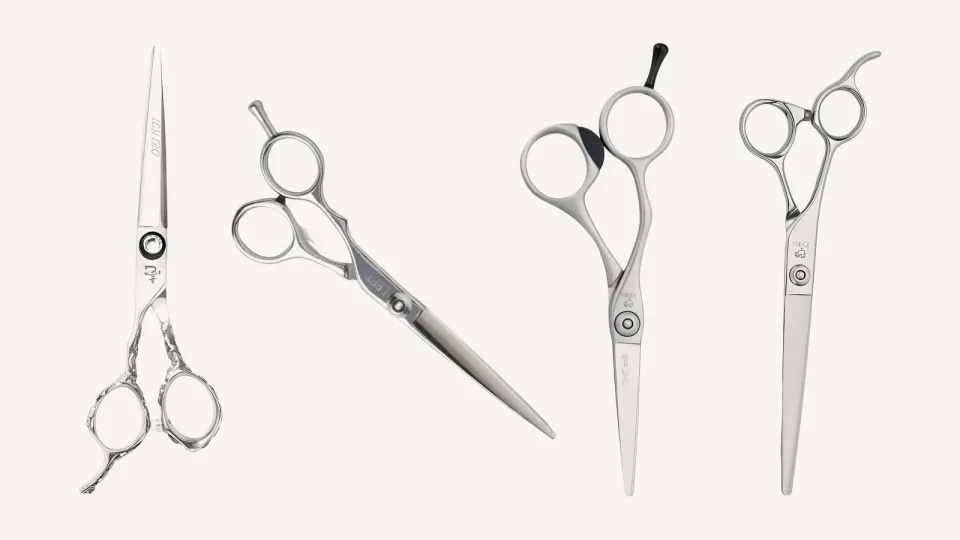
If you cut with your left hand, use a true left-handed scissor, where the blades are reversed as well as the handle. Most training, demonstrations and station layouts assume a right hand, so the rest of the work is learning to mirror what you see and setting your station up your way.
How we chose: Notes follow maker descriptions of true left-handed construction and our left-handed guides. Reviewed 4 November 2026. We sell left-handed pairs and haven’t run cutting tests.
Who it’s for
- Salon
- Barber
- Apprentice
- Left-handed
What is different about a left-handed scissor?
A true left-handed scissor reverses the blade arrangement so that it cuts properly in the left hand. The handle is shaped for the left hand too, but the blades are the part that matters. A right-handed scissor held in the left hand is still mechanically right-handed, even if the rings look symmetrical. It can push the hair out of the blades instead of cutting it, and it hides the line you’re trying to follow.
Look for “Left” in the model or option name, and check the product page, not just the photo. Our left-handed scissors guide explains how to read a listing, and our left-handed collection shows what we list.
-
Look for Left in the name
Pick an option or model that says Left, like the Mina Umi’s Left / 5.5” or Yasaka’s LEFT series.
-
Check the blades, not just the rings
On a true lefty the blades are reversed too. Left-friendly rings on right-handed blades still cut like a right-handed pair.
-
Then choose the handle
Offset, level rings or a 3D handle: pick the grip you’d pick in a right-handed pair.
How do you learn when everything is taught right-handed?
Most demonstrations show a right-handed stylist working from the right side of the client. Your job is to translate. A few habits help:
-
Watch the idea, not the hand
Sectioning, elevation, tension and guide lengths work the same way. Only the direction you travel changes.
-
Mirror it on a mannequin
Rehearse the move in the opposite direction on a practice head before you try it on a client. Photograph the result from your own side.
-
Use a mirror for demonstrations
Where you can, watch a demonstration in a mirror or on video you can flip. Seeing it mirrored reduces the translating you have to do.
-
Ask for a left-handed example
Ask your teacher or salon to pair you with a left-handed stylist if there is one, or to pause and show a move from your side.
-
Keep one change at a time
If a move fights you, change one thing, such as the starting side or the sectioning direction, and see what happens.
How should a left-handed stylist set up a station?
Set up your station so your cutting hand never has to reach across your body for a tool.
- Tools on the left. Put combs, clips and your scissor holder on your cutting-hand side.
- Work from the side that gives you a clear view of the line. Choose the starting side and direction that let you see what you’re cutting, even if it differs from the demonstration.
- Check shared stations. In a salon with right-handed stylists, shared trolleys and holsters may be set up for them. Move things so they suit you.
- Check your holster. Make sure your holster or sleeve sits on the side you reach for.
What does a left-handed kit need?
Every tool that cuts has to be left-handed: the cutter, any thinner and the spare. A thinner in the wrong hand is a common gap. Our left-handed kit plan and left-handed thinning guide cover how to build one.
Some scissors have a reversible finger rest. That changes the fit of the rest, not the blade orientation, so it doesn’t make a pair left-handed. Finger inserts and rests change fit, not the hand.
What goes wrong for left-handed stylists?
- Borrowing a right-handed pair. It works badly, and it hides the line. Keep a left-handed spare.
- Having no left-handed backup. If your only pair goes for service, you have nothing to cut with. See our backup scissors guide.
- Not telling the sharpener. Left-handed edges need a service that preserves them. Our guide to what to ask a sharpener covers it.
- Assuming a handle fixes the hand. An offset or crane handle changes grip geometry, not blade orientation. See our handle and hand posture guide.
- Being told you’re doing it wrong. A mirrored technique is still a technique. Judge the result.
What if you teach or manage left-handed stylists?
Left-handed apprentices often learn from right-handed demonstrations, and they need your help to translate. Show a move slowly from their side, or ask them to mirror it and talk through what they see. Make sure the kit list includes left-handed pairs, and don’t assume a right-handed spare will do.
For salon owners, add left-handed spares to your backup plan, and tell your sharpener which pairs are left-handed. Our guide to buying scissors for a salon team covers the whole kit.
Common questions
Can a left-handed stylist use right-handed scissors?
It’s possible, but it isn’t the same as a true left-handed pair. The blades are arranged for a right hand, so the cutting action and your view of the line change. Many left-handed stylists choose a true left-handed pair.
Do left-handed scissors cost more?
Prices vary by model. The range of left-handed options is smaller than right-handed, so compare what is available in the length and handle you want.
Do I need a left-handed thinner too?
Yes, if you use one. The same blade logic applies to a thinner. See our left-handed thinning guide.
Where can I see left-handed scissors?
Browse the left-handed collection, or read our guide to the best left-handed scissors.
Next step
If you’re choosing a first or replacement pair, start with the left-handed scissors guide. To plan the whole kit, use the left-handed kit plan.
Further reading
For a reference on left-handed scissor terms, Scissorpedia is an information site about hair scissors. Scissorpedia is a fellow member of the ShearAlliance (see ShearAlliance). More topics are in the knowledge base.