Scissor Handles and Hand Posture: A Geometry Guide
By SalonScissors editorial team Updated
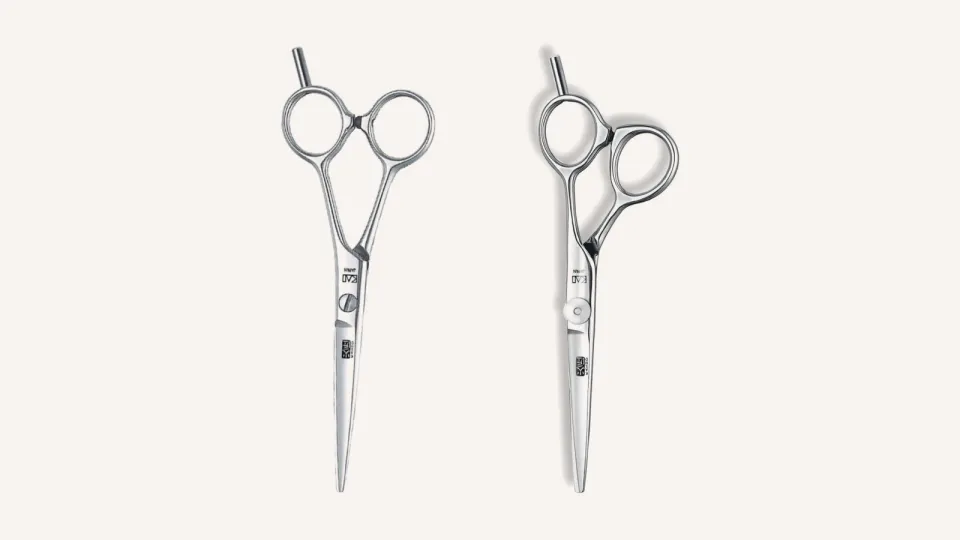
A scissor handle sets the geometry between your hand and the blades: where the thumb ring sits relative to the pivot, how far apart the rings are, and what angle your wrist and fingers hold while you cut. This guide describes that geometry so you can judge a handle against the way you actually work. It doesn’t make health claims, and a handle isn’t a treatment.
How we chose: Geometry notes follow maker descriptions and standard grip practice. Reviewed 4 November 2026. We sell scissors, give no medical advice and haven’t run cutting tests.
How does your hand sit on a scissor?
On a standard grip, your thumb goes in the ring on the moving blade, your ring finger goes in the other ring, and your little finger rests on the finger rest, if the pair has one. Your index and middle fingers rest along the shank or blade for guidance. Only the thumb moves the blade. The other blade stays steady, held by the finger ring and finger rest.
Get that picture clear first, because every handle layout changes one thing: where those contact points sit in relation to the pivot. Our guide to how to hold and open scissors walks through the grip step by step.
What do the handle layouts change?
-
Straight
Both rings sit level, the classic layout. Thumb and finger rings are the same distance from the pivot.
-
Offset
The thumb branch is shorter, so the thumb ring sits closer to the pivot. Most cutters we sell are offset.
-
Crane
A sharper offset. The thumb branch bends, which changes the angle your hand holds the blades at.
| Layout | Geometry | What it changes for your hand |
|---|---|---|
| Straight (level rings) | Both rings the same distance from the pivot | Thumb and finger sit level, with the blades in line with your hand |
| Offset | Thumb ring closer to the pivot | The thumb meets the ring at a different angle, with the hand a little rotated |
| Crane | A more angled, bent thumb branch | A stronger rotation in the hand, which varies a lot between makers |
| Swivel | Thumb ring, or both, rotate on the handle | Lets the ring turn as the angle of your hand changes |
Makers draw the lines between these differently, so compare the side-on photo, not just the name. Joewell recommends symmetric handles for point cutting, since you hold the scissors upright for it. Our broader handle comparison shows a pair in each layout.
How do you test a handle against your cutting positions?
You hold scissors in different positions through a cut, so judge a handle in each of them. A quick check:
-
Palm down
Hold the pair as you would for a horizontal line, such as a perimeter. Check that the thumb and fingers sit without twisting.
-
Palm up
Turn your hand over as if cutting underneath a section. Notice whether the ring stays on your thumb without rubbing.
-
Upright
Hold the blades vertical, as for point cutting. Check that the tips are easy to see and the pair doesn’t tilt.
-
Open and close slowly
Open to the width you use, then close. The thumb should move the blade while the rest of the hand stays still.
-
Check the rings
Look at where the rings touch your skin. A ring that is loose lets the pair shift, and a ring that is tight limits movement.
If a colleague owns a pair in the layout you’re curious about, ask to hold it for a minute. Read our returns page before you buy, so you know what is covered.
What mistakes do people make with handle fit?
- Choosing by name. “Ergonomic” and “crane” describe a shape, not a result. Check the geometry against your hand.
- Ignoring ring size. Rings are fixed, but finger inserts can take up slack. Our first-use fit check covers inserts.
- Changing layouts and expecting it to feel right at once. A new geometry takes a little getting used to. Give yourself a few sessions on a mannequin.
- Treating the handle as the cause of pain. Tool fit is one factor among many in a working day. For ongoing pain, see a health professional. For general work health and safety information, Safe Work Australia is the national body.
- Forgetting handedness. A handle can’t turn a right-handed pair into a left-handed one. See our guide for left-handed stylists.
What should you ask a maker or seller about a handle?
Handle names are loose, so ask for specifics:
- Which rings are fixed, and which turn?
- What is the ring size, and are finger inserts included or available?
- Is there a finger rest, and is it removable?
- What does the side view look like? The angle of an offset or crane handle shows up there.
- Is it available in your hand?
If a seller can’t answer, treat the gap as unknown instead of filling it in. You can ask us about any pair on our contact page.
Common questions
What is the difference between an offset and a crane handle?
Both bring the thumb ring closer to the pivot than the finger ring. A crane handle usually has a more angled, bent thumb branch, but makers use the words differently, so compare photos.
Does an offset handle prevent hand pain?
No handle is a treatment, and we can’t give medical advice. An offset handle changes the angle your thumb meets the ring. Whether that suits you depends on you and your work. If you have ongoing pain, see a health professional.
Can finger inserts fix a handle that doesn’t fit?
They take up space in a ring that’s too big. They can’t change the layout, move the ring, or turn a right-handed pair into a left-handed one.
Which handle is best for beginners?
The one you were taught on, or the one that sits steady in your hand. Our apprentice scissor kit guide covers first pairs.
Next step
Compare layouts side by side in the offset handle range, the crane handle range and the swivel handle range, or use the scissor finder to narrow by hand and handle.
Further reading
For definitions of handle terms, Scissorpedia is a reference site about hair scissors. Scissorpedia is a fellow member of the ShearAlliance (see ShearAlliance). More topics are in the knowledge base.