Hairdressing Scissor Glossary
By SalonScissors editorial team Updated
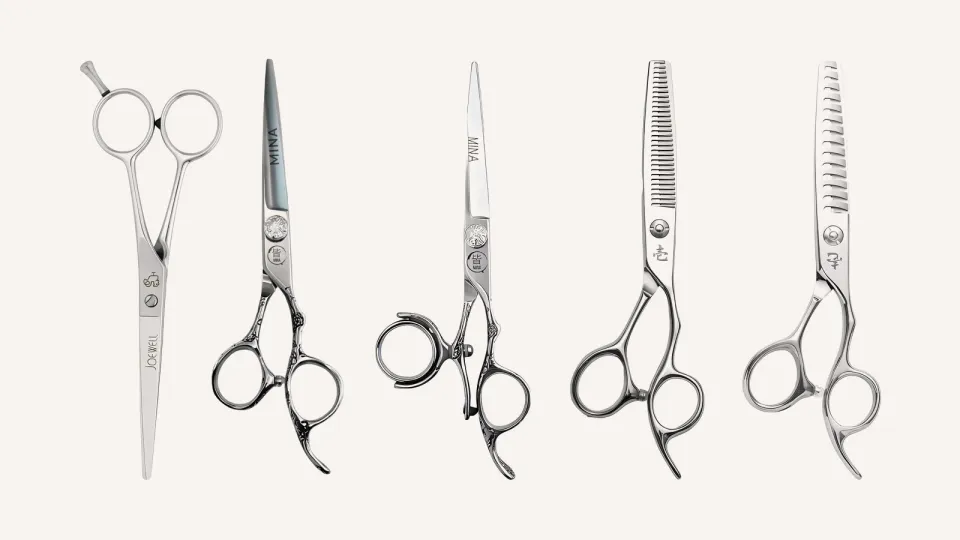
Every word you’ll meet on a scissor listing, plus the cutting and care words stylists use, in a line or two each, with a tip and a link to the guide that goes deeper.
Find a word
How do you read a listing?
Split it into those four parts. Two examples:
“6.0”, Right, Offset, Convex, VG10”
6.0” is the overall size and Right the hand. Offset is the handle shape, convex the edge grind and VG10 the steel. For reach, check the blade length too: the size guide explains the difference.
“5.5”, Left, Straight, 30 teeth, Cobalt alloy”
5.5” and Left are size and hand. Straight usually means a classic handle with level rings, though some listings mean a straight blade. 30 teeth tells you it’s a thinner, not how much it takes out; the cut ratio guide explains why. Cobalt alloy could be either of two very different metals.
Shape: a sword ridge
A raised ridge along the blade makes it a sword profile. It tells you nothing about the edge.
Grind: flat to the edge
This blade, cut across, is bevelled: its outer face is ground flat down to the edge.
Grade: the steel’s name
A grade such as VG10 names one steel recipe from one steel maker.
Process: how it’s made
Powder metallurgy is a way of making steel from powder. It still has a grade, such as SG2.
Look up a scissor term
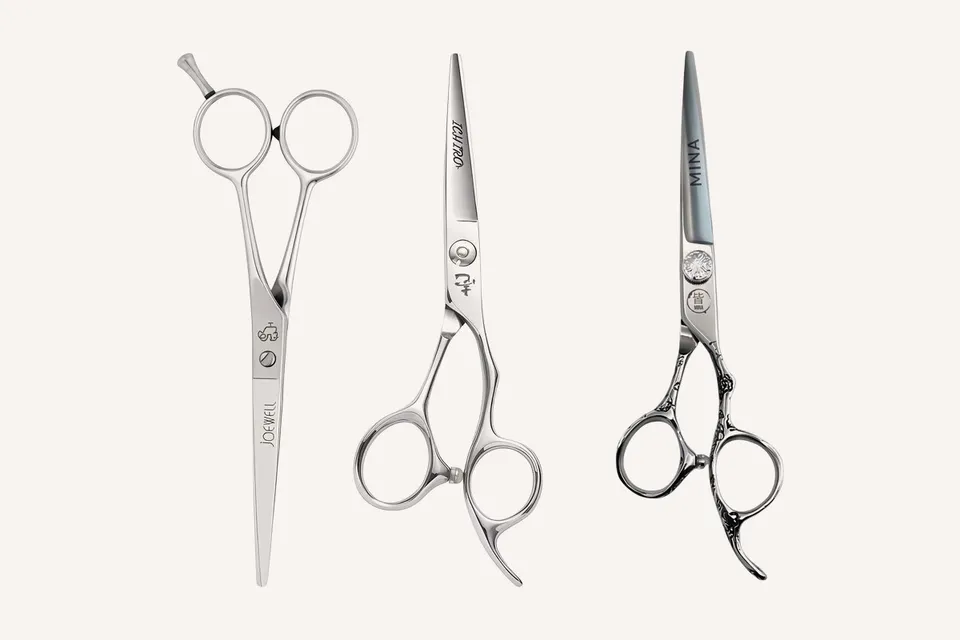
Parts you can name
Know the part names and a fitting or service question takes one sentence.
- Finger rings
Where your thumb and fingers go. A ring insert makes a loose ring smaller.
- Handles
Join the rings to the pivot. Straight, offset or crane changes your grip.
- Pivot
Where the blades turn. The screw here sets the tension.
- Blades
Everything past the pivot. The edge decides how the scissor cuts.
- Tips
Where point cutting and close detail happen.
- Finger rest
A hook for your little finger. Some screw off, some are fixed.
- Pivot
-
Also called: Joint.
The screw joint where the two halves meet and turn as you open and close the scissor.
If the action feels stiff or loose, follow your maker's tension advice before you turn the screw.
- Finger rest
-
Also called: Tang, Finger hook.
The hook beside the finger ring that your little finger rests on. Some are fixed; others screw off.
Check where it sits in your grip, and whether it comes off if you'd rather cut without one.
- Bumper
-
Also called: Silencer, Stopper.
The small stop between the handles that cushions the blades as they close.
If it's missing or split, ask us for the right part for your model.
- Ring insert
-
Also called: Finger insert, Finger ring insert.
A soft ring that fits inside a finger hole to make it smaller.
Ask which inserts fit your model and whether any come in the box.
- Blade
-
The part of each half that does the cutting, running from the pivot out to the tip.
The inch size measures the whole scissor, so look for the maker's blade length when you compare reach.
- Cutting edge
-
Also called: Edge.
The sharpened edge on each blade. The two edges pass each other as the scissor closes, and that's where the hair is cut.
Look along it in good light for nicks, and keep your fingers off it.
- Heel
-
The part of the blade closest to the pivot.
If hair catches at one spot, note whether it's near the heel or the tip when you describe the problem.
- Tip
-
Also called: Point.
The far end of each blade, where you place fine detail and point cuts.
A knock can chip or bend a tip, so look at the tips first after a drop.
- Finger and thumb rings
-
Also called: Finger holes, Handle rings.
The two rings you put your thumb and ring finger through.
They should slip on and off without pinching or wobbling. If a ring is too big, an insert can take up the slack.
- Tension
-
How much resistance the blades give each other as they open and close, set at the pivot.
Adjust in small turns and follow your maker's own check, because the method differs by brand.
- Tension key
-
A small tool that turns the pivot screw to change the tension.
Check it fits your model's screw before you turn anything, because screw heads differ by maker.
Sources for these terms (3)
- Jaguar's scissors ABC: Defines the joint, bumper and finger support.
- Joewell's handle and screw guide: Shows finger inserts and Joewell's screw systems.
- Sam Villa's finger-rest terms: Calls the supports on its blending shear tangs and finger rests.
Size and hand
Size, blade length and hand are three different facts. Check all three on the option you choose.
- Overall length: the inch size
- Blade length: pivot to tip
- Nominal size
-
Also called: Listed size, Inch size.
The inch size on the listing, such as 5.5". It measures the whole scissor, not the blade.
Two 5.5" scissors can have different blades, so check the maker's blade length too.
- Blade measurement
-
Also called: Blade length.
The length of the cutting blade, often in millimetres. Yasaka gives the SA-5.5 a 60 mm blade.
Makers measure from slightly different points, so compare blade lengths within one maker first.
- Left-handed assembly
-
Also called: Left-handed, Left hand.
A scissor built for the left hand, with the blades the other way round so they close together in your grip.
Choose Left on the option itself. A right-handed pair in your left hand pushes the blades apart.
- Overall length
-
Also called: Total length.
The length of the closed scissor from the blade tip to the far end of the furthest ring, leaving off any finger rest. The inch size is this measurement, rounded.
Makers round and measure a little differently, so a 5.5" pair can measure slightly over 140 mm.
- Right-handed assembly
-
Also called: Right-handed, Right hand.
A scissor built for the right hand, with the blades set so they close together in a right-handed grip.
Choose Right on the option itself, because one product page can list both hands.
- Ambidextrous
-
A listing word for a scissor sold as suitable for either hand.
The blades still cross one way, so ask whether it's a true left-handed pair before a left-hander orders it.
Sources for these terms (2)
- Joewell's measurements: Gives size in inches, size in millimetres and blade length separately.
- Sam Villa's swivel shear specs: Lists size, overall length, pivot-to-tip length and hand separately.
Handle layouts
Classic, offset and crane describe the handle's fixed shape. Swivel means the thumb ring turns.
-
Straight
Both rings sit level, the classic layout. Thumb and finger rings are the same distance from the pivot.
-
Offset
The thumb branch is shorter, so the thumb ring sits closer to the pivot. Most cutters we sell are offset.
-
Crane
A sharper offset. The thumb branch bends, which changes the angle your hand holds the blades at.
- Opposing handle
-
Also called: Classic handle, Even handle, Symmetric handle.
A handle with both rings level, the same distance from the pivot.
It suits a straight, balanced grip. If you've only used offset, it will feel different at first.
- Offset handle
-
Also called: Offset.
A handle with a shorter thumb side, so the thumb ring sits closer to the pivot than the finger ring.
The amount of offset varies by model, so compare the handle with the pair you use now.
- Crane handle
-
Also called: Crane.
An offset handle with the thumb side dropped well down. Jaguar describes "a significantly lowered thumb rest".
It changes where your elbow sits, so compare it with your usual grip.
- Swivel thumb
-
Also called: Swivel handle, Rotating thumb ring.
A thumb ring on a joint that turns, so your thumb can move as you cut.
Swivels turn by different amounts. Get used to the movement before you cut on a client.
- Semi-offset handle
-
Also called: Semi offset.
A handle with a mild offset, so the thumb ring sits a little closer to the pivot than the finger ring.
Makers use the word for different amounts of offset, so compare the side view with the pair you use now.
- 3D handle
-
A maker's name for a sculpted handle shaped in three dimensions. Joewell and Yasaka both use the term, and each shapes it its own way.
Compare the side view and ring position with your current pair, because the name doesn't describe the shape.
- Double swivel
-
Also called: Double swivel handle, Swivel rings.
A handle where both the thumb ring and the finger ring rotate.
Give yourself time to get used to the movement before it goes near a client.
Sources for these terms (3)
- Joewell's handle layouts: Explains symmetric and offset handles, and how its offsets vary.
- Jaguar's handle terms: Defines offset and crane handles.
- Sam Villa's crane and swivel shear: Puts a crane handle and a swivel thumb on one model.
Blade and edge words
A listing can describe the blade's shape, the grind down to the edge and the edge's finish. One scissor can have all three.
Convex grind
The outer face curves down to a very fine edge. The inner face is hollowed, so the blades only touch where they cross.
Bevelled grind
The outer face is ground flat down to the edge. Joewell calls its flat single bevel easy to use.
Each grind is drawn as one blade cut across, enlarged. Makers explain their own: Kasho’s edge and Joewell’s blade guide.
- Blade profile
-
Also called: Blade shape.
The blade's shape along its length, from straight to curved, or across it, such as a sword ridge.
Joewell says straighter blades hold hair still and its curved bamboo-leaf blade suits slide cuts.
- Edge grind
-
Also called: Grind.
How the blade is ground down to the edge: convex, semi-convex or bevelled.
The grind sets how fine the edge is. Micro-serration is a separate finish on top.
- Convex
-
Also called: Convex edge, Convex grind.
A grind with a rounded outer face down to a very fine edge, the smoothest choice for slide and point cutting.
For slide cutting, choose a model built for slicing too: the blade line matters as much as the grind.
- Bevelled
-
Also called: Beveled, Bevelled edge, Bevel.
A grind with a flat face down to the edge, at a less acute angle than convex.
Joewell calls its flat single bevel easy to use. It suits blunt lines and learning.
- Semi-convex
-
Also called: Semi convex.
A grind some makers use for an edge that sits between convex and bevelled.
Makers define it differently, so read what the maker says about its own edge.
- Hollow grind
-
Also called: Hollow ground, Hollow edge.
A shallow concave relief ground into the inside face of a blade, so the blades touch mainly where they cross.
It's the inside face, while convex describes the outside, so one scissor can have both.
Micro-serration
Tiny teeth along the edge grip the hair so it doesn’t slip as the blades close. They’re far smaller than a thinner’s teeth.
Sword blade
A raised ridge runs along the blade. Joewell says a sword shape delivers the power to the point of the blade.
- Micro-serration
-
Also called: Micro-serrated, Micro-serrated edge.
Tiny teeth along the cutting edge that grip the hair so it doesn't slip as the blades close.
Good for blunt lines and scissor-over-comb. Skip it for slide cutting, where you want the hair to move.
- Sword blade
-
Also called: Sword profile.
A blade with a raised ridge along it. Joewell says a sword shape delivers the power to the point.
Read the edge separately: a sword blade can be convex or bevelled.
- Bamboo-leaf blade
-
Also called: Leaf blade, Bamboo leaf.
A broad, curved blade outline. Joewell describes its bamboo-leaf blades as suited to slide cuts and slicing.
It describes the outline, not the steel or the edge, so read those separately.
Sources for these terms (3)
- Kasho's edge: Explains its hollow inner and convex outer surfaces.
- Joewell's blade guide: Compares its blade types and blade lines, from straight to bamboo leaf.
- Jaguar's edge terms: Defines convex, bevelled and micro-serrated edges.
Toothed tools
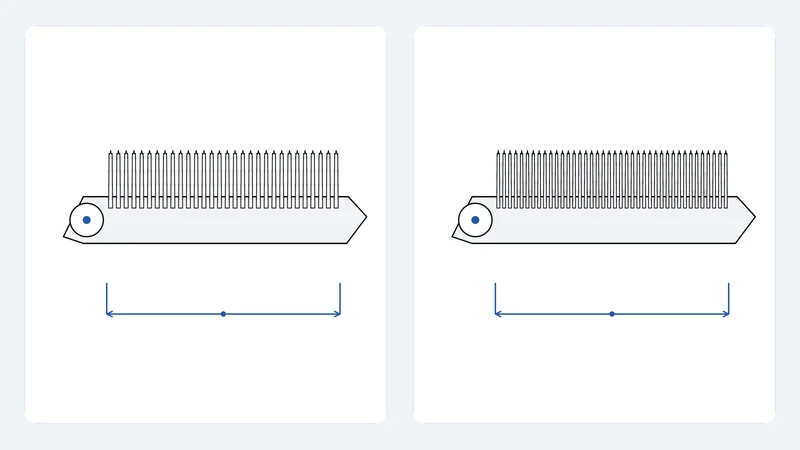
On a thinner, the tooth count, the tooth shape and the cut ratio each tell you something. The cut ratio tells you the most.
- Thinning and texturising scissors
-
Also called: Thinner, Texturiser, Blending scissors.
Scissors with a toothed blade, used to soften lines, take out weight or add texture.
Close-set teeth blend; wide-set teeth leave visible texture. The cut ratio tells you how much each close removes.
- Comb blade
-
Also called: Toothed blade.
The toothed blade on a thinning or texturising scissor.
Look at the gaps and the tips: they change the result as much as the count.
- Tooth count
-
Also called: Number of teeth, Teeth count.
How many teeth the comb blade has, such as 30 or 40.
It isn't a removal rate. Joewell's 40-tooth E-40 and SNT-40 are rated 35% and about 5% or less.
- Cut ratio
-
Also called: Cutting ratio, Thinning ratio, Removal rate.
The maker's estimate of how much of a section a thinner removes in one close, such as 15% or 35%.
Compare ratios within one maker's range first, because makers don't share one test.
- Blender
-
A thinner with many fine teeth, often around 30, made to soften lines and ease weight.
Check the cut ratio too, because two blenders with the same tooth count can remove different amounts.
- Chunker
-
Also called: Chunking scissors.
A texturiser with very few, wide teeth, such as 14, that takes out visible pieces.
Use it after the outline is cut, as a finishing tool, never as your main cutter.
- Tooth geometry
-
Also called: Tooth shape.
The width, spacing, depth and shape of the teeth on a thinner, apart from how many there are.
Joewell says the cut ratio depends on both the number and the shape of the teeth.
Sources for these terms (2)
- Joewell's thinning guidance: Says the cut ratio depends on the number and shape of the teeth.
- Joewell's texturising guidance: Names the thinners it recommends for slide and stroke cuts.
Steel and material
Grade, family, process and pattern are four kinds of material name. Hardness, given in HRC, is a measurement.
- Steel grade
-
Also called: Steel designation.
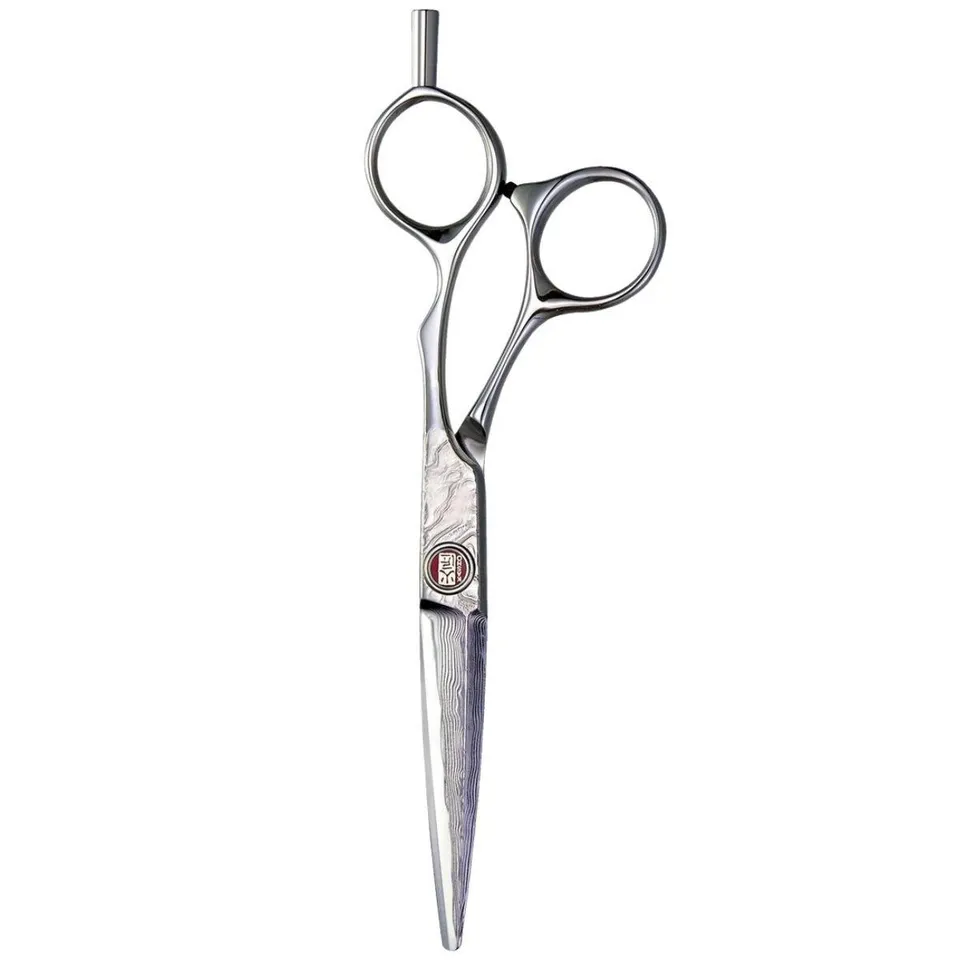
The named steel, such as 440C, VG-10 or ATS-314.
The grade sets how hard the blade can be made; the maker's heat treatment sets how hard it is.
- Cobalt alloy
-
Either stainless steel with a little cobalt, like VG-10's 1.5%, or a cobalt-base alloy like Joewell's CBA-1, which is about half cobalt.
Ask which one it is before you pay cobalt-base prices.
- Powder metallurgy
-
Also called: Powder metal, Powder steel.
Steel made from a fine powder that's pressed and heated solid, such as Takefu's SG2.
A powder-polished finish is something else: it describes the surface, not the steel.
- Damascus
-
Also called: Damascus steel, Damascus pattern.
A blade built from layers of steel, so a wavy pattern shows. Some scissors carry a Damascus-style finish instead.
The steel at the edge does the cutting, so read what the maker says it is.
- Rockwell hardness (HRC)
-
Also called: HRC, Rockwell C.
Hardness on the Rockwell C scale. The steels and scissors in our guides are rated from 58 up to 62 or more.
Higher is harder, not better: a very hard edge can still chip if the scissor is dropped.
- Stainless steel
-
Also called: Stainless.
Steel with chromium added so it resists rust better than plain carbon steel.
It still needs drying after cleaning, because moisture left in the pivot can cause rust.
- 440C
-
Also called: SUS440C.
A high-carbon stainless steel with 16 to 18% chromium. Carpenter's data sheet gives about 60 HRC.
It's a common choice for a first pair. Settle the handle, length and edge before you compare steels.
- VG-10
-
Also called: VG10.
Takefu's stainless steel with 1.5% cobalt, which Takefu rates at 60 HRC or more.
A little cobalt in the steel isn't the same as a cobalt-base alloy, so check which kind a listing means.
- ATS-314
-
Also called: ATS314.
Yamamura's cobalt stainless steel for hair scissors.
Its developer gives no hardness figure, so read what the scissor's maker says about the model.
- SG2
-
Also called: SG2 powder steel.
Takefu's powder steel, which Takefu rates at 62 HRC or more.
It's a steel grade made by the powder process, so read it alongside the edge and the handle.
- CBA-1
-
Also called: Cobalt-base alloy.
Joewell's cobalt-base alloy, which is about half cobalt.
It's an alloy, not a stainless steel, so don't compare it with steel grades by name.
- Heat treatment
-
How the maker hardens the finished blade with heat. The same steel can be treated to different hardness.
Mizutani says the same steel can perform very differently depending on it, so the steel's name is only part of the story.
- Coating
-
Also called: Coloured finish.
A very thin layer applied over the metal, for colour or a harder surface.
The steel and edge underneath do the cutting. Any coating can scratch, so wipe, dry and case the pair carefully.
- DLC
-
Also called: Diamond-like carbon.
Diamond-like carbon: a hard, low-friction carbon coating, usually 1 to 5 µm thick.
It's a coating, so the steel under it is a separate fact to look up.
Sources for these terms (5)
- Takefu's VG10 page: Gives VG10's composition and a hardness of 60 HRC or more.
- Joewell's material guide: Explains cobalt-base alloy and how it differs from stainless.
- Takefu's SG2 page: Explains how its powder steel is made.
- Kasho's Damascus series: Describes the layered V10 cobalt alloy steel in its Damascus blades.
- ASTM E18 Rockwell hardness: The test standard behind HRC figures.
What you're ordering
One product page can hold several options. The option you choose sets the size, hand and price.
- Variant
-
Also called: Selected option, Selected variant.
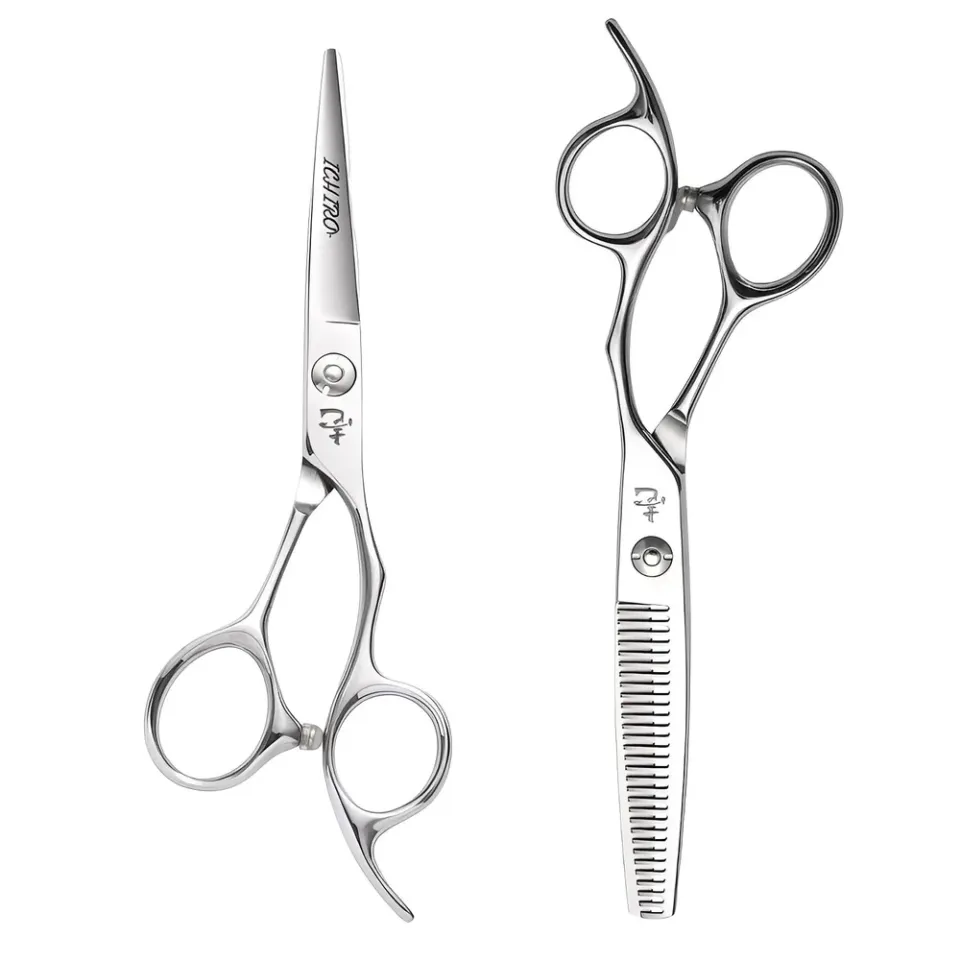
One of the options on a product page, such as a size and hand.
Choose it on the product page. A link to the product doesn't pick it for you.
- SKU
-
Also called: Stock-keeping unit, Stock code.
Our stock code for a product or option. It can differ from the maker's model code.
Quote it when you ask us about an order or a spec.
- Scissor set
-
Also called: Paired set, Scissor kit.
A listing with more than one tool, usually a cutter and a thinner.
Read each tool's size in the option name: changing the cutter size doesn't always change the thinner.
- Cutter
-
Also called: Cutting scissor, Hairdressing scissor.
The main scissor, with two plain blades, used to cut the shape.
Buy the cutter first and add a thinner when the cut needs weight out.
- Barber scissor
-
Also called: Barber shear.
A long cutter, usually 6.5" to 7.0", made for scissor-over-comb.
Keep a shorter cutter for detail around the ears and neckline.
- Warranty card
-
A card some makers pack with a new pair as part of their own warranty.
Keep it with your invoice and the box for any warranty or sharpening claim.
Sources for these terms (2)
- Product variants: Explains variants as combinations of options, such as size and colour.
- Stock codes (SKUs): Explains the codes sellers use to track products and options.
Cutting technique words
These words describe what you do with the scissor, not what the scissor is. Each one changes what you look for in a pair.
- Blunt cutting
-
Also called: Blunt cut, Blunt line.
Closing the blades straight across a held section to cut a defined line.
Almost any good cutter does it, so pick a length that suits your sections.
- Point cutting
-
Also called: Point cut.
Cutting into the ends with the blade tips, to break up a hard line or soften the ends.
Tip control matters more than length. Joewell recommends symmetric handles for it.
- Slide cutting
-
Also called: Slicing, Slice cutting, Slide cut.
Letting the blades glide along the hair as they close, so the hair moves instead of being held still.
Look for a convex edge on a model the maker describes for sliding, and skip micro-serration.
- Scissor-over-comb
-
Also called: Shears over comb, Over-comb.
Cutting the hair a comb lifts, with the comb as the guide for length.
A longer blade covers more of the comb on each pass, which is why 6.5" to 7.0" suits it.
- Layering
-
Also called: Layers.
Cutting sections to different lengths so shorter hair sits inside or over longer hair.
A 5.5" or 6.0" cutter with a convex edge covers most layering.
- Graduation
-
Also called: Graduated cut.
A shape where the lengths step from short underneath to longer on top, which builds weight along the outline.
Much of it is angled work at the back of the head, so a handle that suits that angle helps.
- Sectioning
-
Also called: Sections.
Dividing the hair into smaller parts so you can cut each one in turn.
On thick hair, a smaller, controlled section often helps more than a different scissor.
- Elevation
-
The angle you lift a section away from the head before you cut it.
A bigger angle usually puts shorter hair inside the shape, and a smaller angle keeps more weight.
- Outline
-
Also called: Perimeter.
The length and shape of the hair's outer edge, such as the line of a bob.
A bob is all outline, so your cutter does the whole job there.
- Weight line
-
Also called: Weight.
The place in a cut where the hair looks and feels heaviest.
Take weight out after the outline is cut: a thinner works inside the shape, not on the outline.
- Wet and dry cutting
-
Cutting hair while it's wet or once it's dry. Wet hair is easier to section; dry hair shows how it settles.
Neither is better for every tool, so read what the maker says about the model for dry work.
Sources for these terms (4)
- Joewell's blunt-cut guide: Calls blunt cutting the basic technique and says many scissors suit it.
- Joewell's point-cut guide: Recommends symmetric handles for point cutting.
- Joewell's slide-cut guide: Points to its bamboo-leaf blades for slide cuts.
- Joewell's over-comb guide: Suggests long barber scissors for scissor-over-comb.
Hair words
Hair has its own vocabulary on listings and in guides. Density and strand thickness are different things, so say which you mean.
- Density
-
How much hair grows on an area of scalp.
Dense and coarse aren't the same thing: many fine strands can be dense and fine at once.
- Strand diameter
-
Also called: Strand thickness.
How thick each individual hair is, from fine to coarse.
Fine hair and sparse hair aren't the same, so say which you mean when you ask for advice.
- Shrinkage
-
How much shorter a curl looks once it springs back from its stretched length.
It varies from person to person, so there's no fixed percentage to plan around.
- Texture
-
Also called: Hair texture.
A word that can mean curl pattern, how the hair feels, or the finish a cut creates.
Say which one you mean when you ask us for advice.
Care and service words
Cleaning, tension, sharpening and service are different jobs. Knowing which one you need saves a wasted trip to the sharpener.

- Pivot oil
-
Also called: Scissor oil.
A light oil put on the pivot, a drop where the blades cross, to keep them moving smoothly.
Oil only if your maker says to. Kasho's Millennium and X-treme Perfection series need none.
- Tension drop test
-
Also called: Drop test.
A check where you hold the tips up, open the blades into a cross, let one ring go and watch how far it drops.
Use your maker's version of the check, and adjust in small turns.
- Hair folding
-
Also called: Folding, Pushing.
When hair bends between the blades, or pushes ahead of them, instead of being cut.
Clean the pivot first, then check the tension, then think about sharpening if it carries on.
- Nick
-
Also called: Chip.
A small chip or dent in a cutting edge.
A nick catches hair at one spot. Stop cutting and send the pair for service instead of filing it out.
- Sharpening
-
Also called: Sharpen.
Restoring a worn edge, done by a technician who works on your edge type.
Tell them the brand, the model and what the pair is doing before you post anything.
- Service
-
Also called: Servicing.
Inspection and work on the whole scissor, which can include sharpening, alignment, pivot work and replacing a bumper.
Sharpening is only one part. A damaged pivot or missing bumper needs service, not just a sharper edge.
- Backup pair
-
Also called: Spare pair, Backup scissors.
A second pair kept ready so a drop or a sharpening doesn't cost you a booking.
Match your hand, usual size and handle so it feels familiar from the first cut.
- Disinfection
-
Also called: Disinfecting.
A step separate from cleaning, done with a product your salon approves and following its label.
Wiping and oiling don't disinfect. Follow your salon's rules and the product label.
Sources for these terms (2)
- KAI USA's Kasho FAQ: Gives the tension drop check and says which series need no oil or adjusting.
- Yasaka's precautions: Warns that a drop or knock can chip a blade.
Common questions
Which words matter most when buying a first pair?
Hand, size and handle. Get those right first; the edge and steel come next. Our beginner questions go through a first purchase step by step.
Is a thinner the same as a texturiser?
They overlap. Thinners have close-set teeth that blend and take out bulk; texturisers have fewer, wider-set teeth that leave visible texture. Check the cut ratio to compare them.
Why do listings use different words for the same thing?
Makers and sellers each have their own terms: classic, even and symmetric all mean a level-ring handle, for example. The A to Z list above shows the other names beside each term.
What do point cutting and slide cutting mean?
Point cutting uses the blade tips to break up a hard line or soften the ends. Slide cutting lets the blades glide along the hair as they close. Both are in the technique words above, with the kind of scissor each suits. Scissors for each technique goes further.
Where can I find answers that aren’t a single word?
The FAQ covers choosing, handles, steel, thinners, care, sharpening, delivery and returns in short answers. Each question has its own link, so you can send one to a colleague.
What if a listing leaves out a detail I need?
Ask us with the product link and the detail, such as blade length or hand. We’ll tell you what the maker says, or that it doesn’t say.
Next step
Want the short answers? The FAQ covers the common questions, and the knowledge base collects every guide in one place.
Know what you’re looking for? The scissor finder shortlists pairs by hand, size and budget, and the product photo guide shows what to look for in a picture.