Scissor Length by Technique: 5.0, 5.5, 6.0 and 7.0 Inch
By SalonScissors editorial team Updated
For most salon work, a 5.5” or 6.0” cutter is the everyday length. Go shorter, at 4.5” to 5.0”, for fringes and close detail, and longer, at 6.5” to 7.0”, for long sections and scissor-over-comb work. The inch size measures the whole scissor, not the blade, so use it to compare, not to predict how much hair one closure covers.
How we chose: Guidance follows standard trade usage and maker specification tables. Reviewed 4 November 2026. We sell scissors in all these lengths and haven’t run cutting tests.
Is the inch size the blade length?
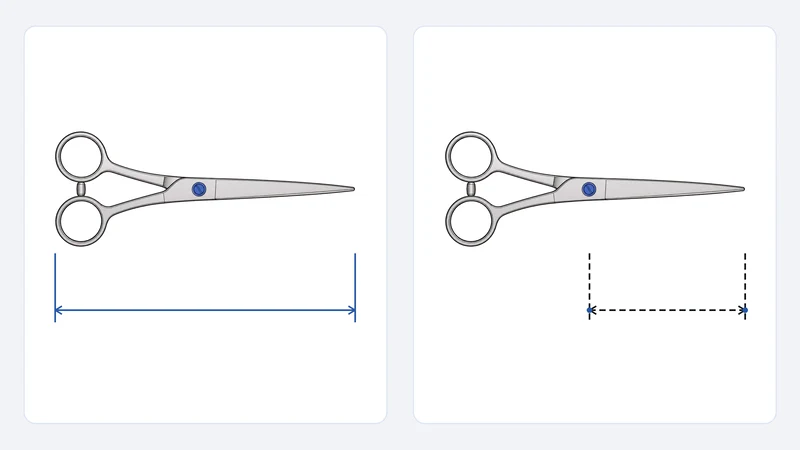
No. The inch size is a nominal size for the whole scissor, and the blade is only the part from the pivot to the tip. Two pairs with the same inch size can have different blade lengths, because handles differ. Makers also measure differently, so compare a maker’s own figures where they give them.
- Overall length: the inch size
- Blade length: pivot to tip
The inch size is the whole scissor. Makers differ on whether a finger rest counts.
The blade is the part that cuts. Two pairs with the same inch size can have different blades.
For example, Yasaka lists a 60 mm blade on its 5.5” SA Classic. That figure is the blade, and the 5.5” is the whole pair. Our size guide shows how to compare two pairs fairly.
Which length suits which technique?
| Technique | Common length | Why | Watch out for |
|---|---|---|---|
| Fringes and detail | 4.5” to 5.0” | Tips sit where you’re looking | Too short for long sections |
| Point cutting | 5.0” to 5.5” | Control of the tips matters more than reach | A long pair can feel unwieldy upright |
| Everyday blunt lines | 5.5” to 6.0” | Enough blade to cut a section in one close | Extra reach you can’t place accurately |
| Layering | 5.5” to 6.0” | Cuts across your fingers in a close or two | Detail near the face needs a shorter pair |
| Slide cutting | 5.5” to 6.5” | Longer blades travel further in a stroke | A catch matters more with a long blade |
| Long, wide sections | 6.0” to 6.5” | Fewer closes along a long line | Hard to control in tight spots |
| Scissor-over-comb | 6.5” to 7.0” | More blade follows more of the comb | Tight spots around the ears |
These ranges describe common habits, not rules. A skilled barber may prefer a compact pair, and a salon cutter may use a long one daily.
How do you choose a length for the work you do?
Start from the cut you do most, then the part you find hardest.
- Mixed salon work: a 5.5” or 6.0” cutter covers most of the day.
- Lots of fringes and short layers: add a short pair for detail. See our guide to cutting fringes and short layers.
- Barbering: a long pair for scissor-over-comb and a shorter one for around the ears. Our scissor-over-comb guide matches the blade to the comb.
- Apprentice: one 5.5” cutter is the usual start. See the apprentice kit guide.
- Small hands or a small working space: choose by reach and control, not by what looks usual.
Your hand and the way you work count too. A pair that feels balanced and lets you see the tips will beat a “correct” length that doesn’t.
Do you need more than one length?
Not at first. One good everyday pair covers most cutting, and a second length earns its place when one job keeps fighting you. A short detail pair is a common second purchase for stylists who cut many fringes, and a long pair for those who work over the comb.
Browse by size to compare: 5.0”, 5.5”, 6.0”, 6.5” and 7.0”.
What mistakes do people make with length?
- Treating inches as blade length. Compare blade figures where the maker gives them.
- Buying long for everything. A long pair is harder to place in detail work.
- Buying short to be “safe”. A very short pair makes long lines take more closes.
- Ignoring handle shape. The handle changes how a given length feels. See our handle and hand posture guide.
- Choosing by looks. Fit and control matter more than the number.
How do you check that a length suits you?
You can judge a length in your hand before you cut anything. Hold the pair as you would for your most common cut, open the blades to the width you normally use and look at where the tips sit.
- Can you see the tips? If your fingers or the handle hide them, the pair may be too long for detail work.
- Does the blade cover the section in one close? If you need three closes to cross a normal section, you may want more blade.
- Does the pair feel balanced? A longer blade moves the weight forward, so check it doesn’t tip in your hand.
- Can you reach the tight spots? Try the angle you use at the ear and the nape.
Read our first-use fit check for the full checks once a pair arrives.
Common questions
What length scissors do most hairdressers use?
A 5.5” or 6.0” cutter is the common everyday length. Many stylists add a shorter or longer pair for specific jobs.
What length is best for fringes?
A shorter pair, 4.5” to 5.5”, with fine tips. You’re working close to the face, so tip control matters more than reach.
What length do barbers use for scissor-over-comb?
Typically 6.5” to 7.0”. The longer blade covers more of the comb on each pass. Keep a shorter pair for around the ears.
Does a longer scissor cut more hair at once?
It has more blade to cut with, but the blade length depends on the model, and not just the inch size. A longer blade is only useful if you can control the tips.
Next step
Use the scissor finder to narrow by hand, length and budget, or read which scissors suit each technique.
Further reading
For a reference on scissor measurements, Scissorpedia is an information site about hair scissors. Scissorpedia is a fellow member of the ShearAlliance (see ShearAlliance). More topics are in the knowledge base.