Scissor Edges in Plain English: Convex, Bevel, Serrated
By SalonScissors editorial team Updated
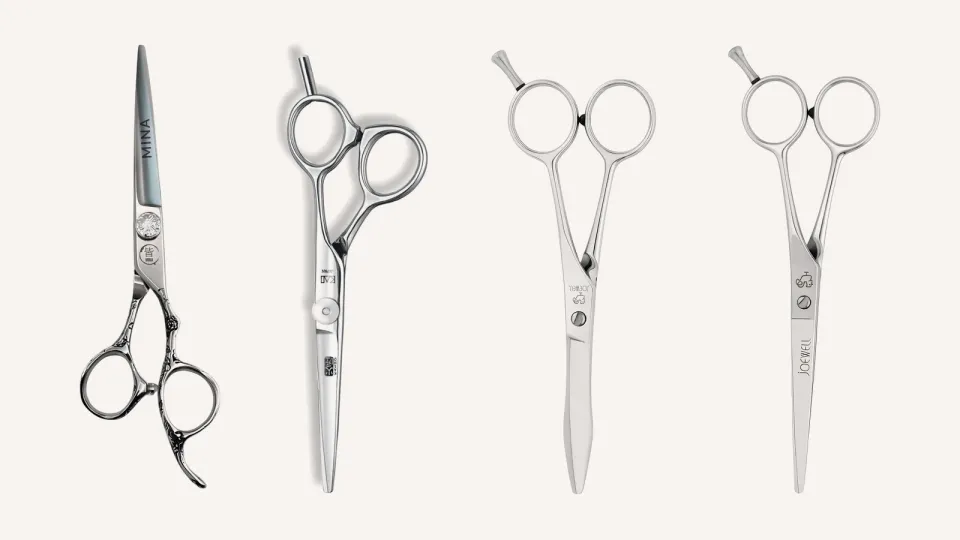
Choose a convex edge to glide and soften, a bevel for firm blunt lines, and a micro-serrated edge when you want the hair to grip. The edge is the thin line on each blade where the two blades meet and cut, and the word on a listing is only the start of the answer.
How we chose: Definitions follow standard trade usage and maker descriptions. Reviewed 4 November 2026. We sell scissors and haven’t run cutting tests.
What do the edge words actually mean?
An edge description describes the shape of the metal where it meets the hair. It’s separate from the blade’s outline, the steel and the handle. Here are the common terms in plain language.
| Word | Plain meaning | What it does to hair | Ask the maker |
|---|---|---|---|
| Convex | The outer face curves down to a very fine edge | Glides and slices smoothly | Is the model designed for slide cutting? |
| Semi-convex | Partly curved, partly flat; the amount varies | Often a mixed, all-round feel | How does the maker use the term? |
| Bevel (flat) | A straight, flat slope to the edge | Holds hair firmly for solid lines | Is it a single bevel or a compound one? |
| Micro-serrated | Fine teeth cut into one blade’s edge | Grips hair so it doesn’t slip | Is one blade or both serrated? |
| Hollow ground | Relief on the inner face of the blade | Reduces contact between the blades | Is it on this model? |
Convex grind
The outer face curves down to a very fine edge. The inner face is hollowed, so the blades only touch where they cross.
Bevelled grind
The outer face is ground flat down to the edge. Joewell calls its flat single bevel easy to use.
Micro-serration
Tiny teeth along the edge grip the hair so it doesn’t slip as the blades close. They’re far smaller than a thinner’s teeth.
Sword blade
A raised ridge runs along the blade. Joewell says a sword shape delivers the power to the point of the blade.
Each grind is drawn as one blade cut across, enlarged. Makers explain their own: Kasho’s edge and Joewell’s blade guide.
Our convex edge guide goes deeper on sharpening and slide cutting, and our blade guide compares grind, finish and shape together.
Why can’t you rely on the word alone?
Different makers use the same word for slightly different things, and some words describe different parts of a scissor. A convex edge, a bamboo-leaf blade and a sword profile aren’t competing grades. One describes the edge, one the outline and one a ridge.
Shape: a sword ridge
A raised ridge along the blade makes it a sword profile. It tells you nothing about the edge.
Grind: flat to the edge
This blade, cut across, is bevelled: its outer face is ground flat down to the edge.
Grade: the steel’s name
A grade such as VG10 names one steel recipe from one steel maker.
Process: how it’s made
Powder metallurgy is a way of making steel from powder. It still has a grade, such as SG2.
A convex edge doesn’t guarantee a good slide cut, and a bevel doesn’t mean a rough cut. The maker’s own description of what the model is for tells you more. Our slide cutting guide and blunt cutting guide show how each edge is used in practice.
Which edge suits which job?
| Job | Edge often chosen | Why |
|---|---|---|
| Slide cutting and softening | Smooth convex | Glides through the section |
| Point cutting | Any clean, sharp edge | Fine tips and a smooth close matter more than the grind |
| Blunt lines on wet hair | Bevel or micro-serrated | Holds the hair for a firm line |
| Scissor-over-comb | Often micro-serrated or bevel | The hair sits against the comb |
| Everyday mixed work | Convex or semi-convex | A good all-rounder |
These are habits, not rules. Your training, your hair and your hands decide. If you’re not sure, start with the edge the maker describes for your most common job.
What four questions should you ask about any edge?
- What is the edge, exactly? Convex, semi-convex, bevel or serrated, in the maker’s words.
- Is it smooth or serrated? And is it one blade or both?
- What is the model made for? Slide cutting, blunt cutting or all-round.
- Who can sharpen it? Edges differ, and some need a technician who knows the geometry. See our guide on what to ask a sharpener.
What mistakes do people make with edges?
- Buying on the word convex. Check the maker’s intended use too.
- Mixing edge and steel. Steel names describe the metal. They don’t describe the edge. See our steel library.
- Expecting a serrated edge to slide. It grips on purpose.
- Sharpening the wrong way. A convex edge needs a technician who preserves the curve.
- Judging edge quality by looking. A closeup photo can’t tell you how the pair cuts.
How can you find out what edge a pair has?
Don’t guess from a photo. A close-up can show a finish, but it can’t show how the edge is ground. Instead:
- Read the listing and the maker’s page for the words convex, semi-convex, bevel or serrated.
- Check what the maker says the model is for. A model described for sliding or for blunt work tells you what the edge is meant to do.
- Ask the seller if the page is silent. A good seller will tell you what they know and say so when they don’t.
- Leave the cell blank in your notes if nobody can tell you.
Our guide to reading product photos shows what a photo does and doesn’t tell you.
Common questions
Is a convex edge sharper than a bevel edge?
Not as a rule. A convex edge is rounded to a very fine line, and a bevel is flat. Both can be sharp. They behave differently in the hair, with the convex edge usually smoother for gliding.
What is a micro-serrated scissor for?
It grips the hair so it doesn’t slip, which helps for blunt lines on wet hair and scissor-over-comb work. It works against slide cutting, where the edge needs to glide.
Can I sharpen a convex edge at home?
We don’t recommend it. A convex edge needs a technician who can preserve the curve. See our guide to preparing scissors for sharpening.
Do I need more than one edge type?
Many stylists work with one good all-round cutter. Add a second edge type only when a job keeps fighting the one you have. See our scissor length guide for the other variable.
Next step
Compare edges across real models in cutting shears, or use the scissor finder.
Further reading
For more on blade and edge terms, Scissorpedia is a reference site about hair scissors. Scissorpedia is a fellow member of the ShearAlliance (see ShearAlliance). More topics are in the knowledge base.